Famous Hotels in Chicago That Shaped the City’s History
A Look at Historic Chicago Hotels, Their Architecture, and the Stories That Helped Define the City
Chicago’s history isn’t just told through museums or landmarks. Some of it is built into the hotels that have hosted presidents, celebrities, and major events over the last century. From early 20th-century icons to long-standing downtown institutions, these properties offer a different way to understand the city.
If you’re looking into famous hotels in Chicago or want to explore historic hotels in Chicago, this guide covers the most notable names and what makes them worth knowing.
See Chicago’s Historic Hotels from the River
Before getting into specific properties, it’s worth mentioning one of the easiest ways to understand how these hotels fit into the city.
Many of Chicago’s most well-known hotels sit along or near the river, surrounded by buildings that shaped the skyline. Taking an architecture cruise gives you context you don’t get from the street—how different eras of construction came together, and where these hotels fit into that timeline.
If you’re planning a visit, you can book the 90-minute architecture boat tour here. It’s a straightforward way to see multiple landmarks in one go, including areas where several historic hotels are located.
The Palmer House Hilton
The Palmer House is one of the longest-running hotels in the city and often comes up first in conversations about historic Chicago hotels.
Originally opened in 1871, it was destroyed in the Great Chicago Fire just 13 days later. The owner rebuilt it, and the hotel reopened in 1873. The current building dates to the 1920s and reflects a more elaborate, European-influenced design.
Inside, the lobby is one of the main attractions. High ceilings, detailed murals, and decorative plasterwork make it stand out even among Chicago’s older buildings.
Over the years, the Palmer House has hosted presidents, actors, and major events. It’s also often mentioned as one of the first hotels to introduce modern conveniences that later became standard, such as in-room telephones, electric lighting, and private bathrooms.
Hilton Chicago
Hilton Chicago
Located on South Michigan Avenue across from Grant Park, the Hilton Chicago is one of the city’s most recognizable historic hotels. Originally opened in 1927 as the Stevens Hotel, it was once promoted as the largest hotel in the world, with thousands of guest rooms designed to accommodate Chicago’s growing tourism and convention scene.
The building reflects the large-scale Beaux-Arts style common during that period, with grand public spaces, high ceilings, and detailed interior finishes that still remain today. Its location also places it close to several of Chicago’s major landmarks, including Museum Campus, Buckingham Fountain, and the lakefront.
Over the years, the Hilton Chicago has hosted presidents, celebrities, athletes, and major political events, helping cement its place among the most important historic hotels in Chicago. Today, it continues operating as both a major convention hotel and a historic part of the city’s skyline.
The Drake Hotel
Located at the northern end of the Magnificent Mile, The Drake Hotel opened in 1920 and quickly became associated with Chicago’s social scene.
Its location, overlooking Lake Michigan, made it a prime spot for visitors arriving in the city. During its early years, it attracted high-profile guests, including celebrities and political figures.
The building itself reflects the luxury style of the early 20th century, with large ballrooms, formal dining spaces, and lake-facing views. Even today, it maintains a more traditional feel compared to newer hotels.
For those exploring historic hotels in Chicago, The Drake stands out for both its setting and its long-standing reputation.
The Blackstone Hotel
The Blackstone Hotel, located near Grant Park, is another key name among famous hotels in Chicago.
Opened in 1910, it became known for hosting U.S. presidents and political figures. The term “smoke-filled room,” often associated with political decision-making, is said to have originated here during the 1920 Republican Convention.
Architecturally, the building reflects early skyscraper design, with a more vertical emphasis compared to older, wider hotel structures.
After going through a period of decline, the hotel was restored and now blends its historical character with modern updates.
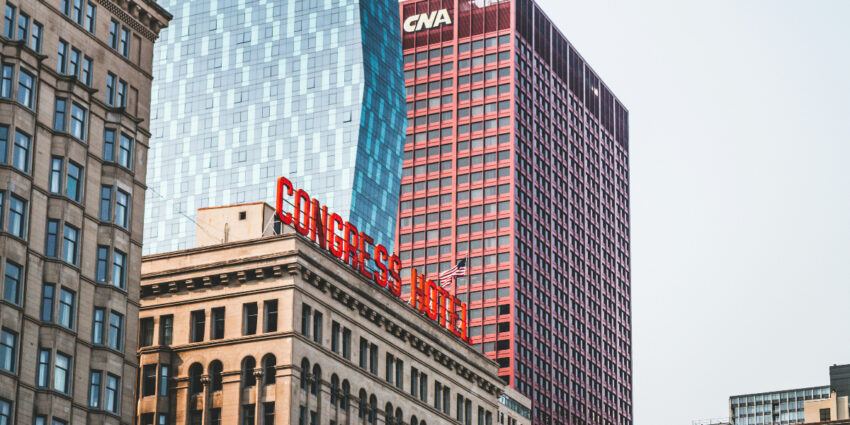
The Congress Plaza Hotel
The Congress Plaza Hotel is one of the older surviving hotels in the city, opening in 1893 during the World’s Columbian Exposition.
It sits directly across from Grant Park, which places it close to many of Chicago’s major attractions.
The hotel is known for its long history and, in more recent years, its reputation for being one of the more “haunted” hotels in the city. While that’s more of a side note, it’s part of what keeps it in public conversation.
From a historical perspective, it has hosted a wide range of guests, including politicians and public figures.
The Chicago Athletic Association Hotel
Originally opened in 1893 as a private men’s club, the Chicago Athletic Association building has been repurposed into a hotel while maintaining much of its original design.
Located along Michigan Avenue, directly across from Millennium Park, it combines historic architecture with a more modern hospitality approach.
Inside, you’ll still find details from its original use, including ornate ceilings, woodwork, and large social spaces.
It’s a good example of how older buildings in Chicago have been adapted rather than replaced.
The InterContinental Chicago Magnificent Mile
The InterContinental stands out because of its unusual origins. Part of the building was originally the Medinah Athletic Club, opened in 1929.
One of its most recognizable features is the indoor pool, which was designed in a style inspired by Spanish and Moorish architecture. It’s still in use today and remains one of the hotel’s defining features.
The building blends historic and modern elements, with a newer tower connected to the original structure.
For visitors interested in architecture, it’s one of the more distinctive properties among famous hotels in Chicago.
The Rookery Building (Hotel Conversion Influence)
While not a hotel itself, The Rookery is worth mentioning because of its influence on how historic buildings in Chicago have been preserved and repurposed.
Designed in part by Daniel Burnham and later redesigned by Frank Lloyd Wright, it represents an earlier phase of Chicago architecture.
Buildings like this helped set the precedent for converting older structures into modern-use spaces, including hotels like the Chicago Athletic Association.
If you’re exploring Chicago, it’s worth taking the time to step inside a few of them, even if you’re not staying overnight. Lobbies, restaurants, and public spaces are often open to visitors and give you a sense of the building’s history.
Pairing that with an architecture cruise helps put everything into context. Seeing the skyline from the river makes it easier to understand how these hotels fit into Chicago’s broader development.